Introduction
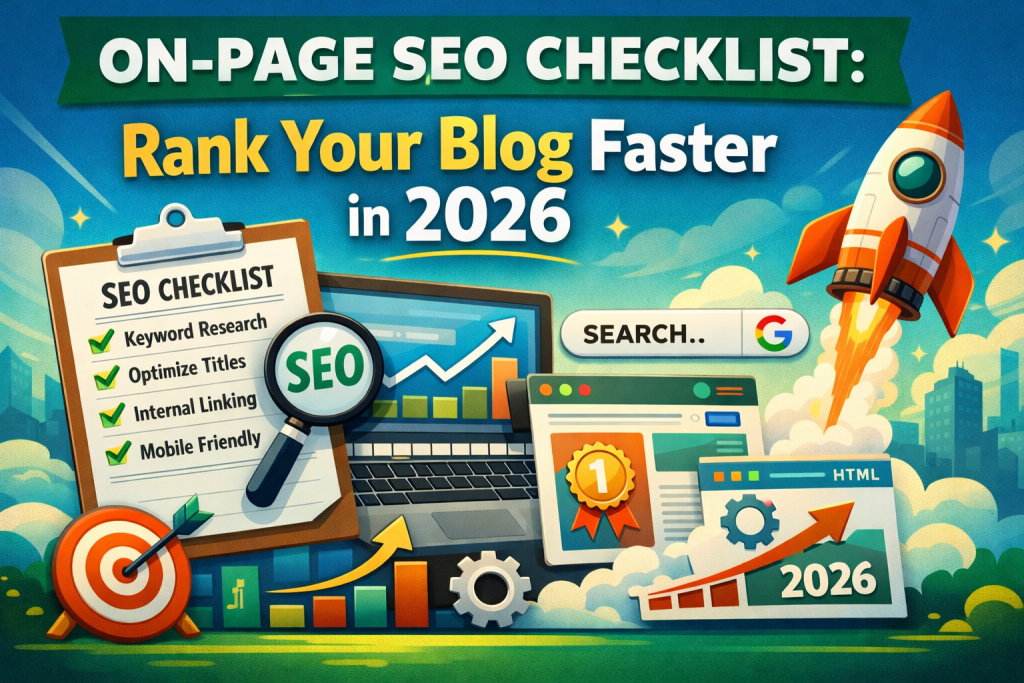
On-page SEO remains one of the most powerful ways to improve your blog’s visibility on Google. In 2026, search engines are smarter than ever, focusing on user intent, content quality, and technical optimization. Therefore on-page SEO checklist is needed to Rank your Blog faster in 2026.
If you want to rank your blog faster without relying heavily on backlinks or ads, mastering on-page SEO is essential.
This guide provides a complete on-page SEO checklist that top bloggers use to optimize their content and achieve higher rankings.
H1: On-Page SEO Checklist: Rank Your Blog Faster in 2026
H2: 1. Keyword Research (The Foundation of SEO)
H3: Why Keyword Research Matters
Keywords help search engines understand your content and connect it with relevant searches.
H3: How to Choose the Right Keywords
-
- Target long-tail keywords
-
- Focus on low competition
-
- Match search intent
H3: Pro Tip
Use your primary keyword naturally throughout the content.
H2: 2. Optimize Your Title Tag (H1)
H3: Why Title Tag is Important
Your title is the first thing users see in search results.
H3: Best Practices
-
- Include primary keyword
-
- Add power words (Complete, Proven, Guide)
-
- Keep it under 60 characters
 Example: On-Page SEO Checklist: Rank Your Blog Faster in 2026
H2: 3. Write a Compelling Meta Description
H3: Why Meta Description Matters
It improves click-through rate (CTR).
H3: Optimization Tips
-
- Include keyword
-
- Keep it under 160 characters
-
- Make it engaging
H2: 4. Use Proper Heading Structure
H3: Importance of Headings
Headings improve readability and SEO.
H3: Structure
-
- H1: Title
-
- H2: Main sections
-
- H3: Subsections
Helps Google understand your content hierarchy.
H2: 5. Optimize URL Structure
H3: Best URL Practices
-
- Short and clean
-
- Include keyword
-
- Avoid numbers and symbols
H3: Example
Good:/on-page-seo-checklist-2026
Bad:/post?id=12345
H2: 6. Use Keywords Naturally (Avoid Stuffing)
H3: Keyword Placement
-
- First paragraph
-
- Headings
-
- Throughout content
H3: Ideal Density
-
- 0.8% – 1.5%
Focus on natural writing.
H2: 7. Optimize Content Quality
H3: What Google Looks For
-
- Original content
-
- Useful information
-
- Clear answers
H3: Tips
-
- Write in simple language
-
- Add examples
-
- Solve problems
H2: 8. Improve Readability and User Experience
H3: Why Readability Matters
Users prefer easy-to-read content.
H3: Tips
-
- Short paragraphs
-
- Bullet points
-
- Use transition words
Improves engagement and ranking.
H2: 9. Add Internal Links
H3: What is Internal Linking?
Linking to your own blog posts.
H3: Benefits
-
- Improves SEO
-
- Increases page views
-
- Helps crawling
H2: 10. Add External Links
H3: Why External Links Matter
-
- Builds credibility
-
- Improves trust
H3: Best Practice
Link to high-authority sites.
H2: 11. Optimize Images for SEO
H3: Image Optimization Checklist
-
- Use compressed images
-
- Add alt text
-
- Use keyword in filename
H2: 12. Improve Page Speed
H3: Why Speed Matters
Slow sites lose rankings and users.
H3: How to Improve Speed
-
- Optimize images
-
- Use caching
-
- Choose fast hosting
H2: 13. Make Your Site Mobile-Friendly
H3: Importance
Most users browse on mobile devices.
H3: Tips
-
- Responsive design
-
- Fast loading
-
- Easy navigation
H2: 14. Use Schema Markup
H3: What is Schema?
Structured data that helps search engines understand content.
H3: Benefits
-
- Rich snippets
-
- Better visibility
H2: 15. Optimize for Featured Snippets
H3: How to Rank in Snippets
-
- Answer questions clearly
-
- Use bullet points
-
- Add FAQ section
H2: 16. Add a Table of Contents
H3: Why It Helps
-
- Improves navigation
-
- Enhances UX
H2: 17. Use Engaging Multimedia
H3: Examples
-
- Images
-
- Videos
-
- Infographics
Keeps users engaged.
H2: 18. Focus on E-E-A-T Principles
H3: What is E-E-A-T?
-
- Experience
-
- Expertise
-
- Authority
-
- Trust
H2: 19. Update Content Regularly
H3: Why Updates Matter
-
- Keeps content fresh
-
- Improves rankings
H2: 20. Add Strong Call-to-Action (CTA)
H3: Examples
-
- Subscribe
-
- Read more
-
- Share content
H2: Common On-Page SEO Mistakes to Avoid
-
- Keyword stuffing
-
- Poor content structure
-
- Ignoring mobile optimization
-
- Slow loading speed
-
- No internal linking
H2: Advanced On-Page SEO Tips for 2026
H3: Optimize for Voice Search
Use conversational keywords.
H3: Build Topical Authority
Create multiple posts around one topic.
H3: Improve User Engagement
-
- Reduce bounce rate
-
- Increase time on page
Conclusion
On-page SEO is the backbone of your blog’s success. By following this complete checklist, you can:
-
- Improve search rankings
-
- Increase organic traffic
-
- Enhance user experience
Success Formula: