Proven On-Page SEO Checklist to Rank Your Blog Faster
On page SEO checklist should be followed. Ranking a blog on Google is not just about writing good content. Even the best article can remain invisible if it is not optimized properly. This is where on-page SEO becomes extremely important. On-page SEO refers to all the optimization techniques you apply within your blog post and website to improve search engine rankings and user experience by going through On Page SEO Cjhecklist.
For beginners and small bloggers, following a proper on-page SEO checklist can significantly speed up rankings, increase organic traffic, and improve visibility on Google. This article explains a complete on-page SEO checklist that helps your blog rank faster and perform better in search results.
What Is On-Page SEO?
Following On-page SEO checklist is the process of optimizing individual blog posts and web pages so that search engines can easily understand the content and rank it higher. It includes optimizing content, titles, headings, URLs, images, internal links, and user experience factors.
Unlike off-page SEO, which depends on backlinks, on-page SEO is fully under your control. When done correctly, it lays a strong foundation for long-term rankings.
Why On-Page SEO Is Important for Faster Ranking
Search engines like Google aim to provide the best results to users. On-page SEO checklist helps search engines understand:
-
- What your blog is about
-
- Who it is useful for
-
- Whether it offers value and clarity
A well-optimized blog post can rank faster even with fewer backlinks, especially for low and medium competition keywords.
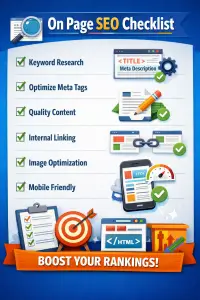
On-Page SEO Checklist to Rank Your Blog Faster
Below is a practical checklist you should follow before publishing every blog post.
1. Keyword Research and Search Intent
Before writing a blog, identify:
-
- One primary keyword for On Page SEO Checklist.
-
- 3–5 related keywords
-
- User search intent (informational, transactional, navigational)
Choose keywords like On Page SEO Checklist that match what users are actually looking for. Writing content without understanding intent slows down rankings.
2. SEO-Friendly URL Structure For On Page SEO Checklist.
Your blog URL should be:
-
- Short
-
- Clean
-
- Keyword-rich
 Best Practice:
yourblog.com/on-page-seo-checklist
Avoid dates, symbols, or unnecessary words. A clean URL improves click-through rate and rankings.
3. Optimize SEO Title (Title Tag)
The SEO title is one of the strongest ranking factors.
Checklist:
-
- Include primary keyword
-
- Keep it under 60 characters
-
- Make it attractive and clear
Example:
On-Page SEO Checklist to Rank Your Blog Faster
4. Write a Compelling Meta Description
Although meta descriptions don’t directly affect rankings, they increase click-through rate (CTR).
Checklist:
-
- 150–160 characters
-
- Include main keyword
-
- Add a benefit or promise
A higher CTR signals Google that your content is relevant.
5. Use Proper Heading Structure (H1–H6)
Headings help both users and search engines understand your content.
Best Practices:
-
- Only one H1 (blog title)
-
- Use H2 for main sections
-
- Use H3 for sub-points
-
- Include keywords naturally
Proper heading structure improves readability and SEO clarity.
6. Optimize Content Quality and Length
Google prefers content that is:
-
- Informative
-
- Easy to read
-
- Well-structured
-
- In-depth
Content Checklist:
-
- Minimum 800–1200 words for competitive topics
-
- Short paragraphs (2–3 lines)
-
- Bullet points and lists
-
- Simple language
Quality content keeps users engaged, reducing bounce rate and improving rankings.
7. Keyword Placement (Natural Only)
Avoid keyword stuffing. Instead, place keywords naturally in:
-
- First 100 words
-
- One H2 heading
-
- Image ALT text
-
- Conclusion
Search engines are smart enough to understand context. Over-optimization can hurt rankings.
8. Image Optimization for SEO
Images improve user experience but can slow down your site if not optimized.
Image SEO Checklist:
-
- Use compressed images
-
- Rename image files with keywords
-
- Add descriptive ALT text
-
- Use relevant images only
Optimized images can also rank in Google Images, bringing extra traffic.
9. Internal Linking Strategy
Internal links help search engines crawl your site better and distribute authority.
Best Practices:
-
- Link to related blog posts
-
- Use descriptive anchor text
-
- Add 2–4 internal links per post
Internal linking improves page indexing and user engagement.
10. External Links to Authority Sites
Linking to trusted external sources improves content credibility.
Checklist:
-
- Link only to relevant, high-quality sites
-
- Use dofollow links where appropriate
-
- Avoid spammy websites
This helps search engines understand your content’s context and trustworthiness.
11. Improve Page Speed and Mobile Friendliness
Google uses page experience as a ranking factor.
On-Page Technical Checks:
-
- Fast loading speed
-
- Mobile-friendly design
-
- Secure HTTPS
-
- Clean layout
A slow website can block even the best content from ranking.
12. Optimize for Readability and UX
User experience plays a key role in SEO.
Readability Tips:
-
- Simple words
-
- Clear sentences
-
- White space between sections
-
- Easy navigation
When users stay longer on your page, Google sees it as a positive signal.
13. Add FAQ Section for Featured Snippets
FAQ sections help:
-
- Rank for multiple keywords
-
- Appear in featured snippets
-
- Improve schema visibility
Example Questions:
-
- What is on-page SEO?
-
- How long does on-page SEO take to work?
-
- Is on-page SEO enough to rank a blog?
FAQs increase topical depth and ranking potential.
14. Use Schema Markup (If Possible)
Schema helps search engines understand content better and improves appearance in search results.
Recommended schema:
-
- Article schema
-
- FAQ schema
Many WordPress SEO plugins enable this automatically.
15. Final Pre-Publish On-Page SEO Check
Before publishing, check:
-
- Grammar and spelling
-
- Broken links
-
- Keyword overuse
-
- Mobile preview
-
- SEO score in your plugin
This final review ensures your blog is fully optimized.
Conclusion
On-page SEO Checklist is the foundation of successful blogging. Without proper on-page optimization, even the best-written content may never reach its audience. By following this on-page SEO checklist, you help search engines understand your blog better, improve user experience, and increase the chances of ranking faster.
Consistency is key. Apply this checklist to every blog post, and over time, you’ll see steady growth in traffic, rankings, and authority. On-page SEO may look simple, but when done