H2. How Digital Marketing Can Transform Education: 7 Powerful Strategies
Introduction
Education is rapidly evolving in the digital age. Traditional methods of promoting schools, colleges, and training institutes are no longer enough to reach modern learners. Today, students search for courses online, compare institutions, read reviews, and interact with educational brands through social media.
This shift has made Digital Marketing in Education one of the most powerful tools for institutions looking to attract students, build credibility, and expand globally. From search engines to social media platforms, digital marketing helps educational organizations connect with students where they spend most of their time — online.
In this article, we will explore how digital marketing can transform education, improve student engagement, and help institutions grow in a competitive environment.
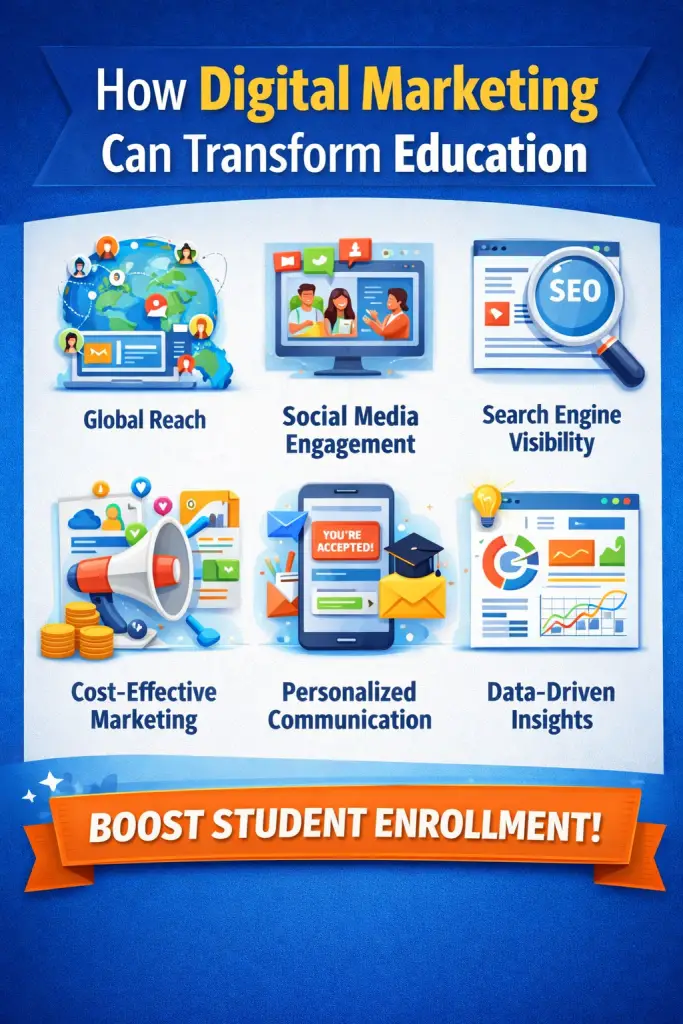
H2. 1. Expanding Global Reach
One of the biggest advantages of Digital Marketing in Education is the ability to reach students worldwide.
In the past, institutions depended on physical advertisements, brochures, and local seminars to attract students. These methods had limited reach and high costs.
Digital marketing removes these barriers by allowing institutions to promote their courses across the globe through:
-
- Search engine optimization (SEO)
-
- Social media marketing
-
- Email campaigns
-
- Online advertisements
With the right strategy, a university in India can easily attract students from Europe, Africa, or the United States.
This global reach opens new opportunities for both students and educational institutions.
H2. 2. Better Student Engagement Through Social Media
Students today spend a significant amount of time on social media platforms like Facebook, Instagram, LinkedIn, and YouTube.
Educational institutions can use these platforms to:
-
- Share educational content
-
- Promote courses
-
- Host live sessions
-
- Answer student queries
-
- Build a strong brand identity
Through Digital Marketing in Education, institutions can interact directly with students and create a community around their brand.
For example, a college can post:
-
- Campus life videos
-
- Student success stories
-
- Webinar announcements
-
- Career guidance tips
This type of engagement helps students feel connected even before they enroll.
H2. 3. Cost-Effective Marketing Strategy
Traditional marketing methods such as TV ads, newspaper ads, and billboards are expensive and difficult to measure.
Digital marketing offers a much more affordable and measurable solution.
Educational institutions can promote their courses using:
-
- Google Ads
-
- Facebook Ads
-
- SEO blog posts
-
- Email marketing
Even small institutions with limited budgets can compete with large universities using smart digital marketing strategies.
Another benefit is that digital campaigns allow institutions to track performance, including:
-
- Number of visitors
-
- Click-through rate
-
- Conversion rate
-
- Student inquiries
This data helps improve marketing strategies continuously.
H2. 4. Search Engine Visibility Through SEO
Most students begin their educational journey with a Google search.
They type queries such as:
-
- Best MBA colleges
-
- Online digital marketing courses
-
- Top universities for engineering
If an institution’s website appears on the first page of search results, it gains a huge advantage.
This is where Search Engine Optimization (SEO) plays a critical role in Digital Marketing in Education.
SEO helps educational websites rank higher in search results by optimizing:
-
- Website content
-
- Keywords
-
- Page speed
-
- Mobile responsiveness
-
- Internal linking
By publishing valuable blog posts and optimizing pages, institutions can attract thousands of organic visitors every month.
H2. 5. Personalized Communication with Email Marketing
Email marketing is still one of the most powerful tools in digital marketing.
Through Digital Marketing in Education, institutions can build an email list of prospective students and communicate with them regularly.
Email campaigns can include:
-
- Course updates
-
- Admission deadlines
-
- Scholarship announcements
-
- Career advice
-
- Event invitations
Personalized emails make students feel valued and increase the chances of enrollment.
For example, if a student downloads a brochure for a business course, the institution can send follow-up emails about related programs and career opportunities.
This targeted communication greatly improves conversion rates.
H2. 6. Data-Driven Decision Making
One of the greatest strengths of Digital Marketing in Education is the availability of data.
Unlike traditional marketing, digital campaigns provide detailed insights into audience behavior.
Institutions can analyze:
-
- Which courses attract the most interest
-
- Which marketing channels generate leads
-
- Which ads convert students
Using tools like Google Analytics and marketing dashboards, institutions can make data-driven decisions that improve results.
For example, if data shows that students prefer video content, institutions can create more educational videos and webinars.
This approach ensures marketing efforts remain effective and efficient.
H2. 7. Building Institutional Brand Authority
Brand reputation is extremely important in education. Students want to study at institutions that are trustworthy and respected.
Digital marketing helps educational organizations build strong authority through:
-
- Educational blog posts
-
- Expert interviews
-
- Online webinars
-
- Student testimonials
-
- Video lectures
By consistently sharing valuable content, institutions position themselves as thought leaders in their field.
A well-maintained website and active social media presence also increase trust among prospective students and parents.
Over time, this strong digital presence becomes a powerful competitive advantage.
H2. Role of Content Marketing in Education
Content marketing plays a central role in Digital Marketing in Education.
Educational institutions can create different types of content, including:
-
- Blog articles
-
- Video tutorials
-
- Infographics
-
- Podcasts
-
- Online workshops
This content not only promotes courses but also educates students and builds long-term relationships.
For example, a digital marketing institute can publish blog posts about:
-
- SEO strategies
-
- Social media marketing tips
-
- Career opportunities in digital marketing
Students who find this content helpful are more likely to enroll in the institute’s programs.
H2. Importance of Mobile-Friendly Websites
Today, most students access the internet through smartphones.
If an educational website is not mobile-friendly, visitors may leave immediately.
Therefore, institutions must ensure their websites are:
-
- Mobile responsive
-
- Fast loading
-
- Easy to navigate
-
- Optimized for search engines
A well-designed website improves user experience and increases the chances of converting visitors into students.
This is a critical element of successful Digital Marketing in Education.
H2. Challenges in Digital Marketing for Education
Although digital marketing offers many benefits, institutions may face several challenges, including:
-
- High competition among universities
-
- Changing search engine algorithms
-
- Maintaining consistent content quality
-
- Managing online reputation
To overcome these challenges, institutions must adopt a long-term strategy and continuously update their digital marketing practices.
Partnering with digital marketing professionals can also help institutions stay ahead in the competitive education market.
H2. Future of Digital Marketing in Education
The future of Digital Marketing in Education looks extremely promising.
Emerging technologies such as artificial intelligence, virtual reality, and personalized learning platforms will further transform how institutions promote and deliver education.
In the coming years, we may see:
-
- AI-powered student counseling
-
- Virtual campus tours
-
- Personalized learning recommendations
-
- Interactive online classrooms
Institutions that embrace digital marketing today will be better prepared for this technology-driven future.
H3. Conclusion
Digital marketing has become an essential tool for educational institutions in the modern world. From increasing global visibility to engaging students through personalized communication, the impact of Digital Marketing in Education is profound.
By using strategies such as SEO, social media marketing, email campaigns, and content marketing, institutions can attract more students and build strong relationships with their audience.
As education continues to evolve in the digital era, institutions that adopt effective digital marketing strategies will gain a significant advantage and remain competitive in the global education landscape.
 SEO Title suggestion:
7 Powerful Ways Digital Marketing in Education Transforms Learning
Meta Description (160 characters):
Discover how Digital Marketing in Education helps schools and universities attract students, build brand authority, and expand globally.
URL Slug:
digital-marketing-in-education